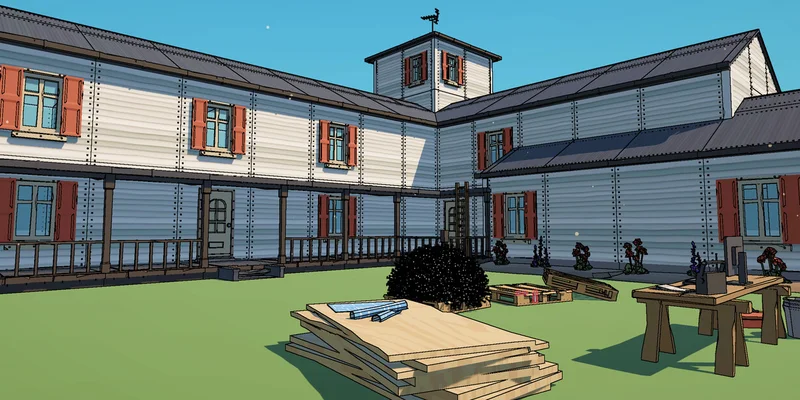
- Hammer these nails game review: A focused look at the repair loop, upgrades, exploration, and progression.
- Best opening focus: Repair small objects first to build money and unlock useful improvements quickly.
- Top upgrade priorities: Increase selection radius, hammer range, nail handling speed, and automatic placement.
- Main milestone: Restore enough of the property to open new areas and work toward the 10,000-nail objective.
- Best strategy: Use dense groups of objects for efficient hammering, then return for difficult high-reach targets.
Hammer these nails Game Review: Core Loop and Appeal
Hammer these nails is a compact repair game built around a simple but effective loop: collect loose nails, place them into missing slots, and hammer damaged objects back into shape. The premise is intentionally strange, but the progression works because every completed object creates a clear sense of improvement.
The house begins in a stripped-down state, with furniture, windows, doors, fences, and outdoor structures waiting to be repaired. Most completed objects provide money, which can then be spent on upgrades. This creates a steady rhythm between exploration, resource collection, restoration, and expansion.
The strongest part of the experience is the physical feedback. Individual nails can be picked up, placed, and removed from the environment. As restoration progresses, the property visibly becomes cleaner and more complete. That connection between each action and the changing environment gives the game more satisfaction than its simple premise might suggest.
Satisfying Restoration
- Repair objects one piece at a time
- Watch missing nails disappear from the environment
- Finish rooms and outdoor structures visibly
Light Progression
- Earn money from completed objects
- Purchase upgrades between repair sessions
- Open new areas through restoration milestones
Oddball Presentation
- Chain lightning adds unexpected chaos
- Ducks provide extra exploration goals
- Strange rooms and unlocks reward curiosity
| Core Element | How It Works | Review Take |
|---|---|---|
| Nail collection | Pick up loose nails around the property | Simple, but increasingly efficient after radius upgrades |
| Nail placement | Put nails into nearby repair slots | Initially slow; automatic placement becomes valuable |
| Hammering | Strike placed nails to complete objects | The most satisfying part of the loop |
| Money | Completing objects provides funds | Encourages short, efficient repair routes |
| Exploration | Unlock rooms, doors, and higher areas | Adds structure beyond basic restoration |
The game’s appeal comes from turning repetitive work into visible progress. Its strange upgrades and hidden discoveries keep the repair loop from feeling flat.
Best Early Route for Fast Progress
The early game rewards players who resist the temptation to repair the largest structure immediately. Large targets can require many nails without offering a better immediate return than several smaller objects. A more efficient opening route is to complete compact furniture, windows, small outdoor pieces, and other nearby targets first.
This approach provides money sooner and lets you improve the tools that affect every later action. Selection radius and hammer range are especially useful because they reduce unnecessary movement. Nail handling speed also matters once the property contains several partially repaired objects.
| Target Type | Early Value | Recommended Priority |
|---|---|---|
| Small furniture | Quick completion and nearby slots | High |
| Windows | Often easy to identify and finish | High |
| Small outdoor objects | Useful for building early funds | High |
| Dog house or similar structure | More nails, but easy to understand | Medium |
| Large fence sections | Dense targets, but slower at the start | Medium |
| Difficult upper targets | May require more reach or jumping | Low until upgrades improve |
Collect a Manageable Batch
Start by gathering enough nails for several nearby objects rather than emptying the entire area. A moderate batch keeps the route organized and makes it easier to see which targets are close to completion.
Finish Small Objects
Repair compact furniture, windows, and simple outdoor pieces first. These targets help generate money without requiring long trips across the property.
Buy Practical Upgrades
Spend early funds on selection radius, hammer range, and nail handling speed. These improvements reduce movement and shorten the time needed for every repair.
Return to Dense Groups
Once your reach and hammering ability improve, revisit fences, benches, walls, and other areas with many nearby slots.
Open the Next Area
Continue restoring the property until the next door or progression threshold becomes available. New rooms can provide more repair targets and additional discoveries.
Large fence sections can consume attention before your upgrades are ready. Repair them when you have stronger range, better placement speed, or an area-effect hammering ability.
Upgrade Priorities and Ability Choices
The upgrade system combines permanent improvements with unusual active abilities. Permanent upgrades are generally the safest early investments because they improve routine actions throughout the entire property. Active abilities become more valuable after several targets are prepared in the same area.
The most useful progression pattern is to improve reach and handling first, then add automation and area effects. This keeps the basic controls comfortable while giving special abilities a clear purpose instead of using them as a substitute for core upgrades.
| Upgrade or Ability | Main Effect | Priority |
|---|---|---|
| Selection radius | Makes nearby nails easier to collect | High |
| Hammer range | Lets one swing affect more distant slots | High |
| Nail handling speed | Reduces the delay between actions | High |
| Extra nails | Increases the number collected per pickup | Medium |
| Automatic placement | Places nails into adjacent slots for a period | High after basic reach |
| Vacuum effect | Helps collect or manage nails from farther away | Medium |
| Chain lightning | Jumps from one hit nail to another nearby nail | High for dense groups |
| Strength | Improves hammering power | Medium to high later |
| Vision or reveal effect | Helps identify missing or incomplete targets | Situational |
A larger selection radius has an outsized impact because it affects gathering, movement, and route planning. Hammer range is similarly important when working on walls, fences, and multi-part structures. Handling speed becomes more noticeable once automatic placement has reduced the time spent manually filling slots.
Chain lightning is the standout novelty ability. It is not necessary for every isolated target, but it becomes entertaining and efficient when several nails are positioned close together. Use it on benches, fences, walls, and other dense repair groups rather than wasting its effect on a single distant nail.
Prioritize selection radius, hammer range, and nail handling speed. Add automatic placement next, then use chain lightning and strength to accelerate dense or late-game repair sections.
| Situation | Best Tool Focus | Why It Helps |
|---|---|---|
| Gathering scattered nails | Selection radius and vacuum | Reduces walking between loose resources |
| Repairing one small object | Handling speed | Makes manual placement and hammering faster |
| Working on a fence | Hammer range and chain lightning | Affects several nearby nails more efficiently |
| Reaching upper sections | Reach upgrades and jumping access | Opens targets that are awkward from ground level |
| Clearing a large wall | Automatic placement and area effects | Prepares and completes many slots quickly |
Exploration, Ducks, and Unlock Milestones
Restoration is not the only reason to explore the property. The environment contains unusual interactions, hidden objects, ducks, doors, and rooms that reward players who inspect areas after improving their movement options. Some targets are difficult to reach until later upgrades make vertical movement easier.
A major progression milestone occurs around the 5,000-nail mark, when a door can be opened and access to an upper interior area becomes available. That area introduces a jumping ability, which changes how the player approaches upper walls, rooftops, and elevated targets.
The broader objective is tied to restoring 10,000 nails. The final stretch is less about finding a new strategy and more about checking every accessible surface carefully. Missing one small object or upper-level slot can delay completion, so a systematic route is more reliable than wandering.
| Milestone | What It Unlocks or Signals | Practical Response |
|---|---|---|
| Early completed objects | First upgrade funds | Buy reach and handling improvements |
| 5,000 nails | Door and upper interior access | Explore the new room immediately |
| Jump ability | Access to elevated targets | Revisit roofs and upper walls |
| Several ducks found | Exploration progress | Search rooms, corners, and upper areas |
| 10,000 nails | Final restoration objective | Sweep the property for remaining slots |
Property Completion Checklist:
- Repair small furniture and nearby outdoor objects
- Complete windows, doors, benches, and wall sections
- Open the door connected to the 5,000-nail milestone
- Use jumping access to inspect upper areas
- Search for remaining ducks and isolated repair targets
- Reach the 10,000-nail restoration objective
If the property appears nearly finished, check upper walls, rooftops, room corners, and objects partially hidden behind larger structures. The last target may be difficult to see from ground level.
Final Assessment and FAQ
The game works best when approached as a short, focused progression experience rather than a deep simulation. Its mechanics are easy to understand, but the combination of upgrades, strange abilities, room unlocks, and visible restoration gives the loop enough variety to remain engaging.
The humor also helps. Chain lightning, unusual movement, collectible ducks, and unexpected interior spaces create memorable moments without overwhelming the central repair task. The result is a deliberately simple game with more personality than its basic objective suggests.
| Category | Assessment | Notes |
|---|---|---|
| Core loop | Strong | Collect, place, hammer, earn, upgrade |
| Progression | Good | New reach tools and areas create useful milestones |
| Exploration | Good | Ducks, rooms, and hidden targets add reasons to search |
| Variety | Moderate | Most progress still centers on repairing objects |
| Accessibility | Strong | Controls and goals are easy to understand |
| Replay potential | Situational | Speed-focused routes may appeal to optimization-minded players |
This is a good fit for players who enjoy satisfying cleanup games, compact upgrade systems, environmental completion goals, and unusual indie-style mechanics.
Q: What is the main objective in Hammer these nails?
The main objective is to restore the property by collecting nails, placing them into missing slots, and hammering objects back into working condition. Progress ultimately leads toward a 10,000-nail restoration goal.
Q: Which upgrades should I buy first?
Selection radius, hammer range, and nail handling speed are the strongest early priorities. Automatic placement becomes especially useful after your basic reach and handling improvements are established.
Q: When can I reach the upper areas?
A door becomes available around the 5,000-nail progression milestone. Exploring the newly accessible interior leads to a jumping ability, which helps reach upper walls and elevated targets.
Q: Should I repair the fence early?
You can, but smaller objects are usually more efficient at the beginning. Return to dense fence sections after improving range, placement speed, and area-effect hammering.