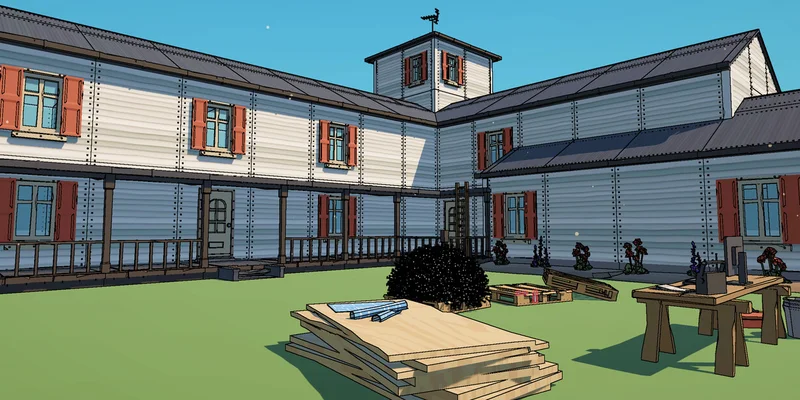
- Hammer these nails first impressions: A focused look at the game’s cozy 10,000-nail objective and progression loop.
- Core loop: Explore, collect nails, complete the hammering action, then review your remaining total.
- Early priority: Clear visible targets methodically before spending time on difficult cleanup areas.
- Progression value: Tool upgrades, automatic pickup and placement, and Chain Lightning are designed to improve efficiency.
- Best mindset: Treat each room as a search route rather than moving randomly between unfinished targets.
Hammer these nails First Impressions: The Core Concept
Hammer these nails first impressions are shaped by a simple but unusually specific premise: locate and hammer 10,000 nails throughout a house and its surrounding spaces. The game presents that objective as a short, focused simulation experience rather than a large combat or story-driven adventure. Its appeal comes from turning a familiar household task into a progression challenge built around exploration, repetition, and increasingly efficient tools.
The central design works because every action supports the same goal. You search an area, identify nails, pick them up when required, complete the hammering interaction, and then use your progress total to decide where to go next. That clarity makes the game easy to understand, while the large target number gives the experience a long-term structure.
The current official Steam listing identifies the game as a single-player experience from developer PIPAPOU and publisher Coduck Studio. It also highlights Steam Achievements, Steam Cloud, Family Sharing, upgradeable tools, hidden doors, and abilities such as automatic pickup and Chain Lightning.
| First-impression element | What it contributes | Early assessment |
|---|---|---|
| 10,000-nail objective | Gives every search and hammering action a clear purpose | Strong, highly focused premise |
| House exploration | Turns ordinary spaces into collectible routes | Best when approached methodically |
| Hammering interaction | Provides the tactile center of the experience | Simple but consistent |
| Upgrade system | Reduces friction during later collection | Important for long cleanup sessions |
| Hidden rooms and doors | Adds discovery beyond visible nails | Encourages revisiting areas |
Simple Premise
The objective is immediately understandable: find nails and finish the hammering task. The game does not require a long tutorial to establish its basic purpose.
Focused Session
The Steam listing presents the experience as a short-form game, making it suitable for players who enjoy a contained objective rather than an open-ended campaign.
Progressive Efficiency
Upgrades and special abilities give the repeated search loop additional structure as the completed total grows.
Do not rush toward the final nail count immediately. Learn the room layout first, complete visible targets, and note areas that deserve a later return.
How the Exploration Loop Feels
The strongest part of the early experience is the relationship between exploration and completion tracking. Nails are not simply a list of collectibles placed on a map. They are targets that encourage you to inspect corners, change your viewing angle, revisit familiar spaces, and consider whether a room has truly been cleared.
A reliable route matters more than fast movement. Searching randomly can make an unfinished room feel confusing because you lose track of which surfaces and corners have already been checked. A consistent entrance-to-exit sweep creates a visual memory of completed sections and makes the final cleanup stage easier.
The game’s structure also supports returning to earlier areas. Newly unlocked abilities or movement improvements can change how efficiently you approach a space. Even if a location looked finished during the first pass, it is worth reconsidering after your toolset expands.
Start With the Main Route
Move through the first accessible space and identify the basic interaction pattern. Approach a nail, collect it when required, and complete the hammering action before moving farther.
Clear Visible Targets
Finish obvious nails during the first pass. Immediate completion reduces the chance of confusing completed objects with targets that still need attention.
Search From Multiple Angles
Inspect high, low, left, and right sightlines when an area appears incomplete. Adjust the camera and position instead of assuming a difficult target is absent.
Record Areas for Later
Mentally mark awkward corners, blocked views, and sections that may benefit from a later ability. This keeps the first route moving without abandoning the cleanup plan.
Finish With a Consistent Sweep
Compare the completed total with the 10,000-nail objective, then revisit explored areas in the same order until the remaining gap becomes clear.
| Exploration phase | Main action | Why it matters |
|---|---|---|
| Opening pass | Follow accessible routes | Builds a reliable map of the environment |
| Visible clearing | Hammer obvious nails immediately | Prevents unnecessary repeat visits |
| Detail inspection | Change camera angle and position | Helps reveal partially obscured targets |
| Progression return | Recheck older spaces | New abilities may improve access or efficiency |
| Final cleanup | Repeat the established route | Makes missing targets easier to isolate |
Repeatedly crossing between unfinished areas can make progress difficult to read. Complete one section as thoroughly as practical before moving to the next.
Upgrades and Abilities: Where Efficiency Improves
The progression system gives the game a useful second layer. Without upgrades, the 10,000-nail objective could feel like a long repetition exercise. With improvements, the same basic actions become more manageable because movement, collection, and multi-target processing receive additional support.
The available information specifically points to automatic pickup and placement and Chain Lightning as notable abilities. These features suggest that progression is not only about making the hammer stronger. It is also about reducing the number of small interruptions between finding a nail and completing it.
Upgrade priorities should depend on the problem slowing you down. If collecting scattered nails takes too much time, collection-focused improvements deserve attention. If the main issue is repeated travel, movement or automation is more valuable. Chain Lightning appears particularly suited to situations where multiple targets can be handled more efficiently.
| Upgrade category | Primary benefit | Best use case | Priority |
|---|---|---|---|
| Tool upgrades | Improve the basic hammering workflow | Regular play and large target groups | High |
| Automatic pickup | Reduces manual collection steps | Scattered nails and busy areas | High |
| Automatic placement | Smooths the transition into hammering | Repeated collection routes | High |
| Chain Lightning | Supports multi-target efficiency | Dense groups or late cleanup | Situational |
| Movement improvements | Reduces travel time | Large or repeatedly visited spaces | High during cleanup |
Collection Efficiency
Prioritize tools that reduce interruptions between locating a nail and beginning the hammering action.
Movement Value
Faster movement becomes more useful when the remaining targets are spread across several previously explored spaces.
Automation
Automatic pickup and placement can make repeated collection routes feel less manual and easier to maintain.
Chain Lightning
Use this ability as an efficiency tool when multiple targets can be processed with less individual handling.
Choose improvements according to your current bottleneck. A movement-focused upgrade is more valuable during long backtracking, while automation helps when individual collection steps interrupt your route.
Doors, Hidden Areas, and Completion Tracking
The house is not presented as a single flat collection field. Doors and hidden rooms give the 10,000-nail objective a sense of progression by making some spaces feel like rewards for continued exploration. The Steam description indicates that certain doors can require progress toward the nail objective, so early exploration should include more than simply checking the most visible surfaces.
This structure changes how you should interpret an apparently finished room. A room may be clear for the moment but still connected to a later route, locked section, or newly accessible space. The best approach is to separate current completion from final completion.
Current completion means you have handled the visible targets available during the present stage. Final completion means every relevant area has been revisited, difficult angles have been inspected, and the total reaches the game’s 10,000-nail goal.
| Location type | First-pass approach | Cleanup approach |
|---|---|---|
| Starting area | Learn controls and clear visible nails | Recheck after gaining useful abilities |
| Standard room | Sweep from entrance to far side | Inspect corners and blocked sightlines |
| Doorway | Note whether access is currently available | Return after meeting progression requirements |
| Hidden room | Search deliberately once unlocked | Confirm that the area is included in final tracking |
| Outdoor or extended space | Use a consistent route | Repeat the same route during final cleanup |
Early Completion Checklist:
- Learn how to approach, pick up, and hammer a nail
- Clear visible targets in each accessible area
- Note doors or spaces that cannot be reached yet
- Recheck corners, edges, and partially hidden surfaces
- Compare the completed total with the 10,000-nail objective
- Wait for the completion state after finishing the final target
A final cleanup pass should be treated as its own phase rather than an accidental extension of normal play. Start with the areas that were visually crowded or difficult to approach. Then follow the same route through the environment, checking each section in a predictable order. This method limits duplicated searching and gives you a clearer explanation for any remaining gap in the total.
Record whether a nail has been collected and whether it has been hammered. The overall goal depends on completed hammering progress, so collection alone should not be treated as the final checkpoint.
Final Verdict and First-Impression Tips
Hammer these nails stands out through commitment to a narrow idea. It is not trying to be a broad action game or a complex narrative adventure. Instead, it turns a familiar task into a structured loop of searching, collecting, hammering, upgrading, and revisiting.
That focus is the main reason the game may appeal to players who enjoy completion goals. The 10,000-nail target provides a clear finish line, while doors, hidden areas, and abilities keep the route from feeling like one completely flat checklist. The experience should be approached patiently: the satisfaction comes from gradually turning a cluttered environment into a verified route.
The strongest practical habits are simple:
- Clear visible targets before exploring complicated corners.
- Use a repeatable route through each space.
- Revisit earlier locations after unlocking useful abilities.
- Treat automation and Chain Lightning as efficiency tools.
- Reserve a separate final sweep for missed or hidden targets.
- Confirm the completion state after the last nail.
| Player type | Likely fit | Reason |
|---|---|---|
| Completion-focused player | Strong fit | The 10,000-nail target creates a clear long-term objective |
| Short-session player | Good fit | The game is presented as a contained single-player experience |
| Exploration fan | Good fit | Doors, hidden rooms, and overlooked surfaces reward inspection |
| Action-game player | Conditional fit | The core interaction is intentionally simple rather than combat-heavy |
| Route-optimization player | Strong fit | Consistent sweeps and upgrades improve collection efficiency |
Q: What is the main objective in Hammer these nails?
The main objective is to locate and complete the hammering action for 10,000 nails. Exploration, collection, upgrades, and hidden areas all support that target.
Q: Are upgrades important during the early game?
Yes. Tool improvements, automatic pickup and placement, movement support, and Chain Lightning can reduce repeated effort as the nail count increases.
Q: Should I revisit areas I already searched?
Yes. Revisit earlier spaces after unlocking new abilities or when your total does not match the route you expected. Difficult angles and hidden sections may require another pass.
Q: What is the safest way to handle the final nail?
Update the game through Steam when an update is available, complete the final hammering action, and allow the completion response to finish before leaving the session.
The best first impression comes from treating Hammer these nails as a focused completion game: explore carefully, upgrade around your bottleneck, and make the final cleanup systematic.