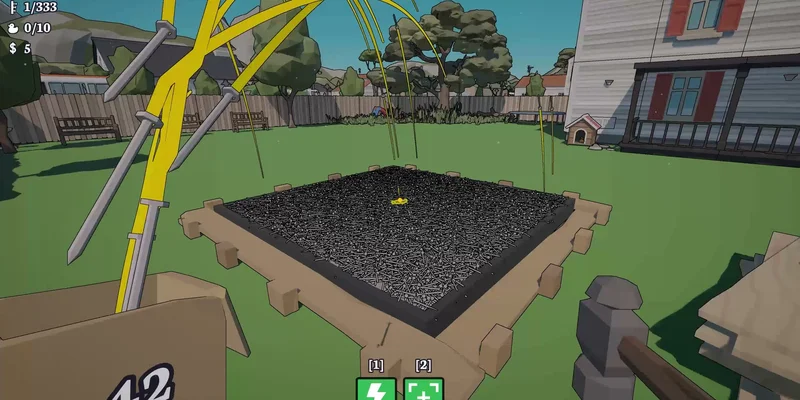
- Hammer these nails speedrun attempts focus on clean execution and consistent resets.
- Any% benchmark: The listed run finishes in 55m04s, providing a practical target.
- Practice priority: Learn movement, interaction timing, and recovery before chasing records.
- Route control: Track splits so weak sections receive focused practice.
Hammer these nails speedrun Overview
The available reference identifies an Any% Hammer these nails speedrun with a completion time of 55m04s. Use that result as a benchmark rather than treating it as a guaranteed target. A strong attempt depends on repeatable inputs, fast decisions, and a reset policy that prevents low-value runs from consuming practice time.
Video Highlights:
- Any% completion format
- Recorded time of 55m04s
- Useful benchmark for personal routing
- Reference point for split planning
| Run Element | Practice Focus | Success Indicator |
|---|---|---|
| Opening section | Fast, repeatable inputs | Few or no early resets |
| Main route | Consistent order of actions | Stable split times |
| Transitions | Movement and menu control | Minimal hesitation |
| Final section | Execution under pressure | Clean finish |
Treat 55m04s as a reference checkpoint. Build a reliable personal route first, then compare individual splits instead of judging every run by the final clock.
Route Planning and Split Structure
A useful speedrun route separates the run into sections that can be practiced independently. Do not begin by memorizing a long sequence without understanding its purpose. Identify the actions that advance progress, the transitions that save time, and the points where a mistake makes a reset worthwhile.
A simple split layout can make improvement measurable:
| Split Type | What to Record | Why It Matters |
|---|---|---|
| Start split | First controlled action | Shows opening consistency |
| Progress split | Major route checkpoint | Reveals pacing changes |
| Transition split | Movement or interaction change | Exposes hesitation |
| End split | Final completion input | Measures closing execution |
Route Memory
Learn the order of required actions before optimizing individual inputs.
Movement Control
Practice the shortest repeatable movement line rather than an unstable risky shortcut.
Reset Discipline
Reset only when the lost time cannot reasonably be recovered during the current attempt.
A route is valuable when you can reproduce it under pressure. A slightly slower line with fewer mistakes often produces better real-session results than a theoretical best line.
Step-by-Step Any% Practice Plan
Use short practice blocks instead of repeatedly restarting full attempts. Each block should have one clear objective, such as learning the opening, reducing transition hesitation, or finishing without panic.
Record a Baseline
Complete a normal attempt without forcing risky optimizations. Record the final time and note where you lost control, paused, or needed to recover.
Divide the Route
Choose three to five practical splits. Give each split a name based on its purpose, such as opening, main progression, transition, or finish.
Drill Weak Sections
Repeat the slowest section until the intended inputs feel familiar. Focus on consistent execution before adding speed.
Add One Optimization
Introduce a single faster action or movement line. If consistency drops sharply, return to the safer version and practice it separately.
Run Full Attempts
Combine the practiced sections and compare splits. Keep notes on the cause of each loss rather than relying only on the final time.
| Practice Session | Main Goal | Recommended Result |
|---|---|---|
| Session 1 | Learn route order | Complete the route without confusion |
| Session 2 | Stabilize opening | Repeat the first split consistently |
| Session 3 | Improve transitions | Remove unnecessary pauses |
| Session 4 | Test optimization | Confirm whether the faster line is reliable |
| Session 5 | Full attempts | Compare splits against the 55m04s benchmark |
Do not reset every time an input is imperfect. Excessive resets reduce useful practice and can make the opening feel harder than the later route.
Consistency, Recovery, and Attempt Management
Speedrun improvement is not only about finding faster inputs. It also depends on recovering from small mistakes without losing focus. A run that is slightly behind schedule may still teach more than an immediate reset, especially when the error occurs in a section you are still learning.
Use these priorities when deciding whether to continue:
| Situation | Continue the Run? | Recommended Response |
|---|---|---|
| Small movement hesitation | Usually | Resume the route and record the time loss |
| Missed optional optimization | Yes | Use the reliable backup line |
| Major route error | Depends | Continue once to practice recovery |
| Repeated early mistake | Usually no | Reset and drill the opening |
| Strong late-game pace | Yes | Stay calm and prioritize completion |
Before a Serious Attempt:
- Know the order of every major route section
- Choose a reset point for repeated early mistakes
- Prepare a safe backup line for risky inputs
- Track splits with consistent names
- Finish several practice runs before chasing a new personal best
A good practice result is not always a new record. A clean late section, a successful recovery, or a repeatable opening can be the improvement that enables the next personal best.
Personal Best Goals and FAQ
Set goals in layers so your progress remains measurable. First aim to complete the route consistently, then reduce the largest individual split, and only afterward pursue a full-run time near the available 55m04s benchmark.
| Goal Level | Focus | Measurement |
|---|---|---|
| Completion | Finish Any% attempts | Number of completed runs |
| Stability | Reduce resets | Reliable opening and transitions |
| Improvement | Lower one weak split | Best section time |
| Benchmarking | Approach 55m04s | Full-run personal best |
| Optimization | Test advanced lines | Speed gained without major inconsistency |
Keep a short run log with the date, final time, best split, and main mistake. Clear notes make the next practice session more productive than repeating attempts without a plan.
Q: What is the Hammer these nails speedrun benchmark?
The available Any% reference lists a completion time of 55m04s. Use it as a benchmark for comparison, not as a guaranteed result.
Q: Should I reset after every mistake?
No. Continue after small errors when the run can still teach you something. Reset repeated early mistakes only when they prevent useful route practice.
Q: How should I practice the route?
Divide the run into practical splits, drill weak sections, add one optimization at a time, and then test the changes in full attempts.
Q: What matters most for a faster attempt?
Consistent inputs, controlled transitions, sensible recovery, and accurate split notes usually matter more than forcing unstable shortcuts.