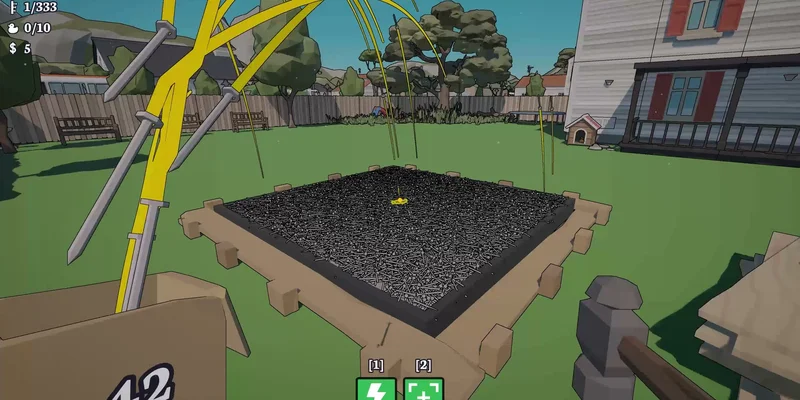
- Hammer these nails 55 minute speedrun planning depends on fast movement and organized searches.
- Upgrade speed first when available, then improve pickup range and interaction distance.
- Clear visible nails before searching roofs, walls, furniture, fences, and hidden corners.
- Use a repeatable route so missed nails are easier to identify during the final sweep.
- Treat 55 minutes as a target rather than a guaranteed result for every run.
Hammer these nails 55 minute speedrun Route
The most reliable approach is to treat the run as a timed collection route rather than a casual building session. The available gameplay material emphasizes movement upgrades, faster hammering, pickup improvements, interaction range, and careful searches through a house-like environment.
A 55-minute attempt should have three goals: establish a clean opening, convert upgrades into faster nail placement, and reserve enough time for a systematic cleanup pass. Do not spend the opening minutes wandering without a plan. Start with visible objectives, learn the room connections, and keep your movement between work areas short.
Video Highlights:
- Upgrade choices can improve hammer speed, pickup range, and interaction range.
- Nails may appear on walls, upper areas, roofs, fences, furniture, and less obvious corners.
- A final sweep is important because a single missed nail can delay completion.
- The run benefits from checking progress counters instead of relying only on visual confidence.
| Run phase | Main objective | Recommended focus |
|---|---|---|
| Opening | Build early momentum | Collect nearby nails and learn the room layout |
| First upgrades | Improve action speed | Prioritize hammer speed or movement-related value |
| Main clear | Finish obvious work areas | Move in a consistent room-to-room order |
| Cleanup | Find remaining nails | Check upper surfaces, furniture, fences, and corners |
| Final check | Confirm completion | Use counters and revisit suspicious locations |
Choose a route you can repeat. A slightly slower path with fewer missed locations is usually more useful than a fast path that creates a long cleanup phase.
Visible First
Clear nails that are easy to see before investigating hidden or elevated locations.
Short Transitions
Group nearby work areas together to reduce unnecessary walking and repositioning.
Upgrade Windows
Spend currency when an upgrade immediately improves the next section of the route.
Counter Checks
Compare your progress with the expected total before committing to the final sweep.
Upgrade Priorities for Faster Clears
Speedrun upgrades should be judged by how much time they save over the entire route. The gameplay reference includes improvements connected to hammering speed, pickup amount, pickup range, interaction range, movement, electric nails, and related utility systems.
For a 55-minute target, direct action speed is the safest early priority when it is available. A faster hammer reduces the time spent on every active work area. Pickup range becomes more valuable once nails are spread across floors, corners, or cluttered spaces. Interaction range can help when the player must approach awkward objects or collect items without perfect positioning.
Not every upgrade has the same value at every point in the run. A utility upgrade may be useful later, but buying it too early can slow the progress needed to reach the next major improvement.
| Upgrade category | Speedrun value | Best timing | Practical reason |
|---|---|---|---|
| Hammer speed | High | Early or mid-run | Reduces time spent completing each nail group |
| Movement speed | High | Early | Shortens travel between rooms and structures |
| Pickup range | Medium to high | Mid-run | Helps collect scattered nails with fewer adjustments |
| Interaction range | Medium | Mid or late | Makes awkward objects and distant interactions easier |
| Pickup amount | Medium | After route is stable | Reduces repeated collection trips |
| Electric or special effects | Situational | After core speed | Useful when it clearly accelerates the current route |
| Maximum statistics | Late-run value | When affordable | Helps finish optimization but may not be the first purchase |
Do not spend early currency on an upgrade simply because it is available. If it does not improve the next route segment, save resources for a direct speed, movement, or collection benefit.
A useful decision rule is to ask three questions before every purchase:
- Will this upgrade affect several minutes of the next section?
- Does it remove repeated walking, aiming, or pickup actions?
- Can the route reach the next upgrade without unnecessary detours?
If the answer is unclear, continue the current route and reassess after the next progress checkpoint. This keeps the run focused on measurable time savings rather than a fully upgraded build.
Step-by-Step 55 Minute Attempt
Use the following sequence as a flexible framework. The exact room order can vary, but the principles remain consistent: work in clusters, preserve momentum, and delay broad searches until the main visible work is complete.
Establish the Opening Route
Start with nearby nails and obvious unfinished surfaces. Learn which spaces connect naturally, then choose a direction that avoids crossing the same area repeatedly.
Secure the First Useful Upgrade
Spend early currency on an upgrade that directly improves hammering, movement, or collection. Avoid long shopping detours while the map still contains easy progress.
Clear Each Work Cluster
Finish one wall, room, floor, or nearby structure before moving to the next cluster. This makes unfinished areas easier to recognize and limits backtracking.
Expand the Search Pattern
After visible nails are handled, inspect upper walls, roofs, fences, furniture, stairs, and corners. Use improved range or movement to reduce awkward positioning.
Run the Final Counter Check
Compare the remaining total with the locations already checked. Revisit areas with unusual geometry before assuming the last nail is in a completely new location.
The strongest speedrun habit is separating progress work from search work. Progress work means placing nails that are already easy to identify. Search work means investigating locations where one or more nails may be concealed by height, furniture, walls, or unusual angles.
| Time block | Task | What to avoid |
|---|---|---|
| 0–10 minutes | Visible nails and basic layout | Random exploration without collecting |
| 10–25 minutes | Main room or structure clusters | Rechecking cleared areas too early |
| 25–40 minutes | Upgrade-assisted clearing | Buying upgrades unrelated to the current route |
| 40–50 minutes | Elevated and hidden locations | Searching one corner repeatedly without a pattern |
| 50–55 minutes | Counter-based cleanup | Assuming completion before checking totals |
If a route segment begins taking longer than expected, stop and identify why: slow hammering, poor positioning, excessive travel, or a missed upgrade opportunity.
A run does not need to feel frantic to be fast. Consistent movement, clean camera positioning, and a fixed search order often produce better results than constant rushing. The goal is to remove hesitation from repeated actions.
Search Pattern for Hidden Nails
The final minutes are usually decided by search quality. The reference material describes checking upper walls, roofs, fences, furniture, stairs, corners, and areas that may be easy to overlook. That suggests using a layered sweep instead of scanning randomly.
Begin at the player’s current position and inspect the environment in vertical layers. First check the floor and nearby objects. Then inspect walls and furniture. Next look upward toward ledges, rooftops, upper walls, and elevated structures. Finally, check outside boundaries such as fences or objects near the edge of the playable space.
| Search layer | Locations to inspect | Sweep method |
|---|---|---|
| Ground level | Floors, lower walls, nearby objects | Move in one direction and finish the immediate cluster |
| Mid level | Furniture, tables, benches, door areas | Check behind and beside large objects |
| Upper level | Stairs, upper walls, ledges, roofs | Look upward before leaving each structure |
| Boundary level | Fences, outer walls, corners | Follow the perimeter instead of cutting across |
| Progress check | Counters and unfinished sections | Match the number remaining to the route log |
Final Sweep Checklist:
- Check every visible wall and unfinished surface
- Inspect roofs, upper walls, stairs, and elevated corners
- Search around furniture, benches, tables, and door areas
- Follow fences and outer boundaries in one direction
- Confirm the remaining counter before ending the run
When one nail remains, do not restart your entire route immediately. Review the locations already marked as checked, then focus on unusual geometry and areas that required jumping or awkward positioning.
A simple route log can be mental or written: room cleared, upper section checked, exterior checked. This prevents the most common cleanup error—returning to familiar areas while leaving one difficult location unexamined.
Practice Plan and Run Evaluation
A 55-minute goal should be approached through repeatable practice. Start by learning the environment and identifying the order that produces the fewest crossings. Then practice the first upgrade sequence separately from the final search. Combining both too early makes it difficult to tell whether a slow attempt came from routing, purchases, or missed nails.
Use each attempt to record one or two practical observations:
- Which section created the longest travel time?
- Which upgrade changed the pace of the run?
- Where did the final missing nail appear?
- Which locations were checked twice?
- Did the final cleanup begin early enough?
| Practice focus | Success indicator | Adjustment for the next attempt |
|---|---|---|
| Opening route | Nearby nails are collected without wandering | Set a fixed first cluster |
| Upgrade timing | Purchase improves the next work section | Delay low-impact utility purchases |
| Room order | Few returns to previously cleared spaces | Group adjacent locations |
| Hidden search | Upper and exterior areas are checked once | Use a vertical and perimeter sweep |
| Final cleanup | Remaining total is known before the last minutes | Start the search phase earlier |
A stable route with clear checkpoints is the foundation for a 55-minute attempt. Once missed locations and unnecessary detours are removed, faster execution becomes easier to measure.
The best run is not necessarily the one with the most aggressive movement. It is the attempt where every action has a purpose: collect, upgrade, clear, verify, or search. If an attempt misses the target, use the failure point to refine the route instead of changing everything at once.
Q: What is the main goal of a Hammer these nails 55 minute speedrun?
The goal is to complete the nail-clearing objective within roughly 55 minutes by combining an efficient route, useful upgrades, and a disciplined final sweep.
Q: Which upgrades should be prioritized first?
Hammer speed and movement-related improvements are strong early priorities because they can save time across many actions. Pickup range and interaction range become more useful when the route reaches scattered or awkward locations.
Q: How should I find the last missing nail?
Use a layered search. Check floors, walls, furniture, upper areas, roofs, stairs, fences, and corners. Compare each location with the remaining counter so you do not repeat random searches.
Q: Is 55 minutes guaranteed with this route?
No. The 55-minute mark is a practical target, not a guaranteed result. Execution speed, upgrade timing, route familiarity, and missed locations can all change the final time.